
Robots today are distracted by the sheer volume of visual noise in the real world. They see pixels, but they miss the point. This paper introduces HRP (Human-to-Robot Affordance), a method that acts as a stimulant for robotic learning. By extracting specific affordance data, like hand poses and contact points, from human videos and injecting them directly into the robot's visual brain, HRP forces the model to focus on the critical interaction between hand and object. This review breaks down how HRP works, why it outperforms standard self-supervised learning, and where the integration of tactile sensing, like Morpheus Robotics' technology, can further add critical contact affordance information.
important definitions
(For more context on these terms, visit the Morpheus Robotics Research Glossary)
Affordance
James J. Gibson coined the noun "affordance" by deriving it from the English verb "to afford," meaning "to provide" in The Senses Considered as Perceptual Systems (1966). Gibson proposed that organisms possess perceptual systems evolved to detect threats and opportunities, rather than passively receiving raw sensations. Crucially, affordances are relational. They do not exist solely in the object or solely in the mind. They emerge from the relationship between the environment and the organism's capabilities. A water surface affords support to a water strider insect, but not to a heavy mammal. In robotics, this means a cup affords grasping only if the robot understands where and how its gripper fits onto the handle.
Gaussian Mixture Model
A probabilistic model used to represent normally distributed sub-populations within an overall population. In this paper, it is used to standardize the irregular, messy cluster of pixels where a hand touches an object into a clean mathematical shape that the neural network can process.
Loss Functions
Training penalties that force the AI to pay attention to specific variables. In HRP, these force the model to focus on the hand pose, the active object, and the contact point.
Semantic Information
This refers to the meaning of the data rather than its physical appearance.
Semantic Classification Loss
A training penalty used to teach the model what things are. If the model looks at a picture of a knife and thinks it is a spoon, the loss (error) is high. The system adjusts itself to minimize this error, thereby learning to classify objects correctly.
Suitable Representations
These act as the bridge between visual data (pixels) and semantic information (utility). It captures not just that an object is red and round (visual), but that it is an apple meant for eating (semantic). In the context of this paper, a suitable representation is a data-rich embedding vector (specifically, size 768, generated by ViT-B) that captures not just what an object is, but its relationship to the robot's end-effector (hand).
Self-Supervised Learning (SSL)
A machine learning method where the model learns from unlabeled data. While powerful for general vision, standard SSL often struggles to understand physical interaction without explicit guidance.
Vision Encoder
This is the visual processing center of the AI. It takes raw input (pixels from a camera) and compresses it into a mathematical summary (embedding) that the rest of the robot's brain can process. In this paper, the Vision Encoder is a Vision Transformer (ViT-B).
the paper's hypothesis
The authors argue that traditional Self-Supervised Learning models, when trained on human video data alone, are insufficient for robotic manipulation. While these models can recognize objects, they fail to extract the affordances.
Their hypothesis rests on three pillars:
- Blind spots in current AI: Standard models cannot spontaneously learn affordances, like where to grasp, just by watching videos. They fail to focus on what is important in the scene.
- Hidden value in video: The necessary labels, such as hand poses and object states, are hidden within human videos and can be mined using off-the-shelf computer vision pipelines.
- Mono-modal data is insufficient: Human data alone, without this explicit affordance injection, does not provide enough information for robots to handle unseen scenarios (OOD tasks).
the paper's approach
The researchers propose a method called HRP (Human-to-Robot Affordance). Instead of training a robot solely on raw pixel data, HRP extracts rich interaction data from videos to guide the robot's learning.
The Pipeline
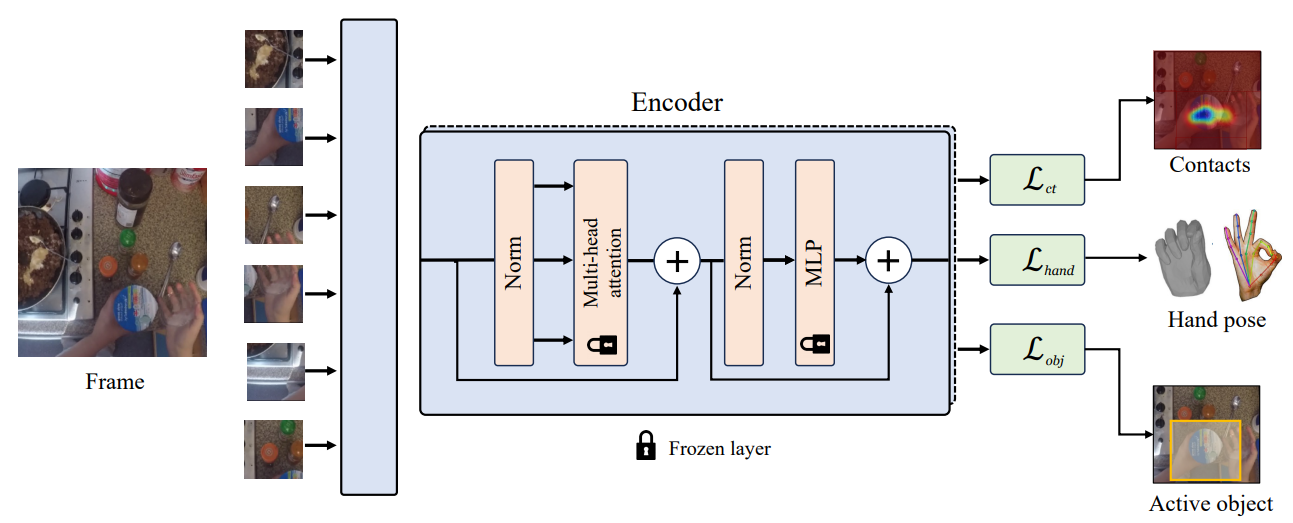
- Mining the Data: They utilize existing vision tools to process human video datasets (like Ego4D).
- FrankMocap: A system using a ResNet-50 backbone to predict 3D hand poses from 2D video frames. This paper uses this for hand pose estimation.
- 100 Days of Hands (100DOH): A ResNet-based model that tracks objects and hand positions using MANO. This paper uses a hand object detector model to extract the contact/interference between them.
- Standardizing Contact: Real-world contact ranges from a fingertip pinch to a full palm grasp, but an embedding vector cannot accommodate varying input sizes. To resolve this, HRP standardized the data into a fixed format using a Gaussian Mixture Model (GMM). More on the consequences of this decision later.
- SIFT Feature Tracking: Used to track objects and contact points forward and backwards across frames. They use it to compensate for camera movement and occlusion, as well as provide information for the approach and release of an object.
- Looking into the Future: To capture intent, the model identifies contact points 30 frames (approx. 1 second) ahead. This allows the system to learn the approach trajectory, not just the final grasp.
- Injecting Affordances: Finally, they use a Vision Transformer (ViT-B) as the visual encoder. They apply specific loss functions while minimizing disturbance to the model's general visual understanding. They freeze the model weights, training only the normalization layer.
findings and conclusions
The HRP method demonstrates that affordance information is not just nice to have, but critical for robust robot learning.
- HRP vs. 100DOH Pre-training: A key finding is that HRP significantly outperformed models that just used 100DOH representations. While 100DOH is good at detecting hands and objects, it is primarily a classification and detection tool. It tells you that a hand is present. HRP, however, forces the encoder to predict the hand's 3D mesh, the specific contact point, and the future trajectory. This forces the encoder to learn the interaction, not just the semantic category. The result is a representation that understands the shape and physics of the grasp, not just the presence of a hand.
- Knowledge Isolation: The authors found that the most effective way to apply HRP is to fine-tune only the network normalization layer. This preserves the pre-trained knowledge while adapting the model to focus on interaction.
- The Contact Paradox: Interestingly, while object and hand information were critical, removing the contact affordance had a marginal effect on performance. The authors speculate this is due to noise and uncertainty of the extraction process. I have a different opinion on the matter, explained below.
reviewer's opinions & analysis
The value of affordances in machine learning is intuitive. As children, we learn by watching our parents. We observe how they approach, grasp, and manipulate a spoon that they used to feed us. We do not simply look at the spoon and mathematically deduce its utility. We emulate the interaction. HRP suggests that machines require this same relational context.
The Limitation of Current Vision Models
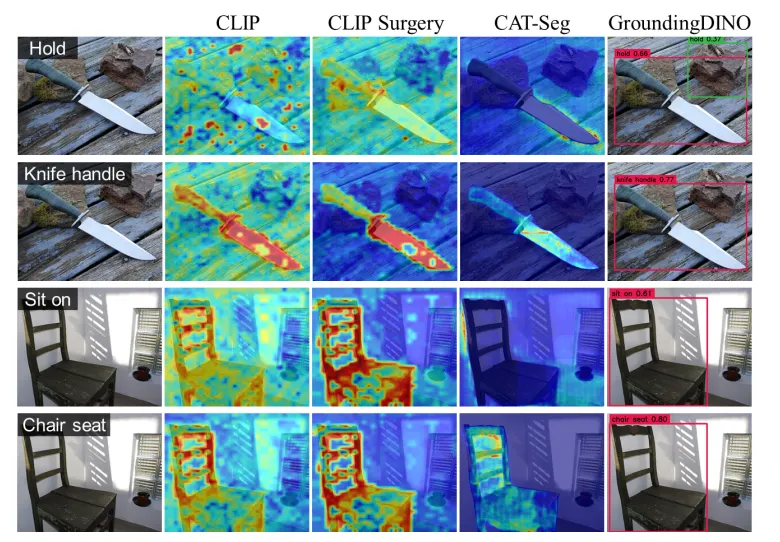
There is a growing body of work showing that current Vision-Language Models (VLMs) struggle to bridge the gap between semantic and visual knowledge. It is one thing to recognize a knife (visual); it is another to realize that the handle is graspable and that the blade can be sharpened and used to cut things (semantic).
A compelling visualization from One-Shot Open Affordance Learning with Foundation Models (Figure 2, below) highlights this issue. It shows that while models like CLIP can recognize an object, they often fail to localize fine-grained functional parts, such as a handle or a seat.
HRP addresses this by distilling affordances into an embedding vector. This aligns with broader trends in post-training, where the goal is to increase data density to learn new tasks without catastrophic forgetting, erasing what the model already knows. Their finding regarding Layer Norm fine-tuning echoes the concept of knowledge insulation, popularized by Physical Intelligence in their pi0.5 model.
Why Affordances Boost Robustness
One of the paper's more interesting outcomes is the robustness HRP provides across different camera views and robot embodiments. I speculate this is because affordances are invariant properties. A mug handle affords grasping regardless of whether you view it from the left, the right, or top-down. If a model learns to recognize the pixels of a handle, it might fail when the lighting or angle changes. However, if the model learns the graspability of that geometry, that concept remains stable across viewpoints.
Similarly, this explains the success of cross-embodiment. The concept of approaching a handle is universal, whether the arm is a human arm or a robotic Kuka arm. By distilling the representation down to the affordance itself, HRP effectively decouples the interaction from the visual representation of the action, allowing for easier transfer across different robot bodies.
The Contact Problem and the Morpheus Solution
While HRP is a step forward, I agree with the authors that 3rd-person human video data (YouTube, TV shows) has a ceiling. It is inherently difficult to extract rich contact data from these sources.
The paper admits that contact loss had a marginal impact, but it's not due to noise. When relying on a monocular camera view, determining the exact interface between a finger and an object is a guessing game plagued by occlusion and lighting shifts. The model tries to simplify this using Gaussian Mixture Models, but pixels are not touch.
This is where the industry must evolve.
To truly solve general-purpose robotics, we need to fill the data gap with ego-centric video data paired with high-fidelity tactile sensing. The complexity HRP faced in estimating contact patch size vanishes when you have a finite number of tactile sensors with fixed geometry.
Unlike pixels, tactile sensors provide:
- Normal and shear force feedback.
- High-fidelity surface information.
- Certainty of contact.
At Morpheus Robotics, we believe that trying to infer touch from vision alone is an unnecessary handicap. By using humans to collect massive-scale data, including granular tactile information, we can provide the rich contact information that HRP attempted to approximate. This multi-modal approach is the key to training the next generation of capable, general-purpose robots.